Well what a week that has been, in fact the past two weeks have been pretty full on. At moments I have felt a little overwhelmed, when I have contemplated the amount of work I have got to do, but when I have zoomed in what needs to be done and just got cracking it has been thoroughly enjoyable.
This week started off quietly, I had set aside Monday initially for admin. An opportunity to catch up on some paperwork and start planning for events I have planned in the next few months. One event in particular at the end of the month has been playing on my mind, a team coaching coaching event exploring and understanding the system in which a particular service lives. The aim of the event is to identify and articulate the relationships the service has and doesn’t have with other parts of the system, and assess which relationships, need strengthening, building or downgrading, to ensure the service operates effectively within the system. There is a lot of moving parts with this event, and quite a bit of preparation is needed, hence why it has been praying on my mind. So I spent the first part of the Monday morning revisiting my plans, and starting some of the prep work. When preparing for a group coaching session it is important not to fall into the trap of over engineering it and at the same time ensuring you have prepared the participants and created enough structure to ensure the session flows.
My colleagues were in the office which always creates a wonderful creative atmosphere, where we share ideas and offer each other different perspectives. In the afternoon I had a meeting about some potential work coming up in November. This is why I mentioned feeling a little overwhelmed by the amount of work that we have coming our way over the next few months. Monday was a day for a helicopter view, to ensure I was clear about what I still need to plan for and make sure I was fully prepared for the work I had to do this week. However when I was up there looking down it was a little daunting, so I did not stay up there too long before I came down and started preparing for the delivery work I had in my diary for the rest of the week.
On Tuesday I met with my colleague to run through the clinical supervision training we had planned for Thursday and Friday this week. It has been quite a few months since we have delivered this training so we just needed to make sure we were ok with the running order and who was doing what. In the afternoon I was delivering a webinar for one of our inhouse leadership programmes on Team Effectiveness. I love the subject but after a few years of delivering training via webcam I can honestly say it is not my favourite medium to deliver training, I much prefer in person training. The incidental side conversations where a lot of the learning happens does not happen naturally online. Saying that we had some useful conversations and the session went very well.
Wednesday was spent with a team of senior nurses providing specific leadership development designed for how they work and lead together as a team. The focus of todays session was how to use a coaching approach to leadership, conducting challenging conversations and the use of feedback in the moment to support team members performance and development. It was a wonderful session to be part of with everyone in the room actively taking part creating really rich conversations. I was buzzing at the end of the day. The feedback I got from those in the room was that they all were going to take away something from the day that they were going to start using at work.
Thursday was day 1 of our 3 day clinical supervision training. My colleague who co-facilitates with me and manages the training was unfortunately ill, so myself and another colleague who was coming along to observe as part of her role as Professional Nurse Advocate co-ordinator ran the day. We train Nurses and AHPs how to conduct clinical supervision on a one to one basis. We have an ever growing network of clinical supervisors from a variety of healthcare professions. Our Nursing and Midwifery colleagues also have the opportunity to complete PNA (Professional Nurse Advocate) or PMA (Professional Midwife Advocate) certificate. We had 8 candidates this time (we keep it to a maximum of 12 per cohort to maximise the learning). We had a Midwife, 4 Nurses, an ACP (Advanced Clinical Practitioner), a Radiotherapist and a Physiotherapist. The group gelled really quickly and the day went really well.
Friday was day 2 of clinical supervision training, it was a pleasure being in the room with these wonderful health professionals. The day just flew by and I was truly blown away by their skill and willingness to be vulnerable and learn.
When I got home on Friday evening I was exhausted. It has been such a full on week, but one of those weeks where I feel I have got so much done and made a difference. Weeks like this remind me why I love my job so much, and why I love coaching so much. They make up for those frustrating moments where it feels like nothing is going right.
I have posted this before, I wrote it a few years ago, when I did my Connected Living Podcast. I think it is worth sharing again, as we all need a reminder how easy it is to be consumed by our shame.
Our shame diminishes us; it stops us being vulnerable and therefore connected with those around us. Shame can quickly turn into blame, and jealousy, it encourages us to search for what disconnects us rather than what connects us.
When I think about what I am ashamed of, I realise that I have heard a lot of the descriptions I use from other people. We share a lot of our shame with the people around us. How ridiculous is that? So we all share common themes in the very thing that causes us not to share and drives our disconnection!
Now not all of our shame is shared by everyone, however the broad themes of our shame are. To illustrate this I will list a few things that create feelings of shame in me;
Not being handy, I am completely inept at all things DIY, every time a craftsman does some work around my house I feel that I am somehow less of a man. (I know it makes no sense and what I can and cannot do does not define me, but that is my initial feeling).
Having poor mental health, when my mental health is poor and my mood is low, I instantly go to a place of shame. I want to hide it away, I am afraid that I appear weak and flawed. Now this is an initial response, and I am able to overcome this shame, however every time I feel low I go straight to feeling ashamed and wanting to hide away.
Being overweight, I am not comfortable with how I look, it makes me feel like I am somehow a failure. I can hear you all shouting “go on a diet then!” You are right, I could do something about it. I have made attempts in the past with varying degrees of success. This then drives that shame of being weak willed and a complete failure. Oh god I can feel my jaw getting tight with shame just writing about it.
Some of you will recognise those feelings of shame that I have described. There are a lot more where they came from, but let’s not over share.
The society and culture I live in drive the three triggers of shame I have described. If you are going to be a successful man in our society you have to be able to build and maintain your home, keep your shit together and be strong and athletic, amongst many other things, which I probably do not possess.
Our shame and vulnerability is shaped by our map of the world (our paradigm). It is probably best to describe paradigms before we start to talk about how to tackle our shame and embrace our vulnerability.
Stephen Covey describes paradigms as our maps of the world. What is important to remember though is that a map is an interpretation of the territory before us and not the actual territory. It is important to make this distinction, as we will all have different interpretations of our territory even though we may share that territory with others. Our experiences and how we interact with our territory will determine how we draw/paint our map. The stories we are told will all add to the detail of our maps. The stories we hear come from a variety of sources, not just our families, but from our local community, news media, social media, and fictional media. This therefore creates a rich and detailed map that does share some similarities with those people we share a culture with. Below is a picture that is used frequently to describe paradigms and perception. Some of you will recognise it, and be able to see both the old lady and the young lady. Some of you will only be able to see one or the other.
Once you see either the old lady or the young lady for the first time, your paradigm has shifted and more detail is added to the map of your world. You will forever be able to see both. As we interact more with our surroundings the more detail we add to our map. These interactions create more data, which is then incorporated into our ever expanding map, however how we view this data is dependent on our previous experience with similar data. The problem is those previous experiences may not be our own, and may come from stories, many of which might not be completely factual. Can you see why parts of our map of the world might not be completely useful to us, and in fact can be destructive? It is important to challenge ours and others paradigms if we want to start to step out of this shame that our paradigms can generate.
So how do our paradigms shape our shame? It is probably best if we dissect some of the shame I experience and discover where it comes from. Let’s look at the shame driven by my body image. This is based on a few different paradigms. Firstly I see that our culture values men that are slim, muscular and athletic, and I am none of them, however if I ate correctly and exercised regularly I would have a body like this. Our society values people that eat healthily and exercise well, therefore I see people that live up to this ideal as successful. I do not live up to this ideal therefore I am not successful. Occasionally I will make half-hearted attempts to live up to this ideal and then give up, therefore I am a failure and therefore I am less valuable as a person, and that is where my shame comes from. If we don’t live up to our paradigms we can feel less valuable as a member of our community and this makes us feel ashamed. There is no reason why I don’t live a healthy lifestyle other than I choose not to, and if I don’t challenge my paradigm I feel really ashamed of this.
Up until a few years ago I was a smoker, this was a source of great shame. Everyone knows smoking is unacceptable (another paradigm), therefore every time I lit up a cigarette I would feel ashamed, every time I tried and failed to give up I would feel more ashamed. To all of you out there that smoke, you know it is bad for you, you know all of the reasons why you should give up, however the reasons you continue to smoke are just as valid. By all means feel guilty for smelling like an ashtray and making others cough. But your smoking does not diminish you as a person, I would still like you if you are funny and caring, you being a smoker does not change that, so don’t be ashamed, feel guilty but not ashamed. Guilt does not diminish you as a person, it accepts that you are as complex and flawed as the next person, and that we make mistakes and make poor decisions.
So how do we keep our shame in check? I don’t believe we can ever defeat our shame but we can keep it in check. The first thing to do is to think more critically about why we feel ashamed. What is our view of the world based on? Is it based on fact, or from stories we have been told. If it is based on stories, how accurate are those stories? Our paradigms come from our memory banks, and the problem with our memory banks is that they are generally a mix of fact and fiction. Therefore how reliable are our paradigms. If our paradigms struggle to stand up to critical review, why do we put so much store in them, and why should they drive so much shame? Just asking yourself why you think that way, can start to diminish your shame.
Let’s put this to the test with my body image shame. My shame is partly driven by my inability to stick to a diet and healthy lifestyle. When I think about it, the paradigm I am stuck in, is that I should find living a healthy lifestyle easy and therefore my inability to do this means I am somehow less of a person.
Now how does this stand up to scrutiny?
What evidence do I have that supports this paradigm?
Pictures of smiling toned healthy people on social media telling me how much they enjoy drinking kale and beetroot smoothies, and doing the plank.
How reliable is this source? Have I ever seen someone drinking a kale and beetroot smoothie or doing the plank in the flesh?
No I haven’t.
Have I ever drunk a kale and beetroot smoothie, if so what did it taste like?
Yes I have and it was the most disgusting thing ever.
Have you ever done the plank, and if so did you feel like smiling when you were doing it?
Yes I have, and no, I tried not to be sick if I am honest.
Just writing this has reduced my shame.
When you start picking apart your shame and what drives it, you start to treat yourself with empathy, you start to understand your own emotional response to your shame, this allows you to show yourself some compassion. Brene Brown in her books Daring Greatly, and Dare to Lead suggests that empathy is the antidote to shame. Empathy and compassion shine a light on that shame.
We are more accustomed to hearing about empathy and compassion in the context of showing them to others. Brene however also points out that, to truly be able to show empathy to others you have to be comfortable showing yourself empathy. Once you have started to diminish your shame you are able to successfully articulate your emotions when feeling that shame. When a friend is experiencing shame you are then able to draw on your own experience of shame, and can share those emotions with them. When we start sharing what shames us we start to recognise that many of the paradigms that drive our shame are shared by the people around us. When we notice that we share those emotions, and that diminishes the shame further.
By being present and responding to what is really happening, rather than anticipating what might happen based on what we believe has happened in the past, or what we believe people will think of us, and sharing those feelings, we can keep our shame in check. I don’t think it is possible to banish our shame completely but we can prevent it from ruling our lives.
We can often confuse guilt with shame. Now guilt is an emotion we feel after we have behaved badly or done something wrong. Guilt is nothing like shame. When you behave badly and subsequently feel guilty you are acknowledging that you have behaved in a way that you do not find acceptable, and that you are sorry that you behaved that way. Guilt provides the opportunity to make amends, to show accountability. By expressing guilt you are saying that you are not less of a person because of your behaviour, and you want to make it better. Shame says that as a result of your behaviour you see yourself as a bad person. For example if I feel guilty that I have not been able to stick to a diet, I am saying that I am not happy that I have not been able to stick to it, but I am not a failure, I do however need to find a diet and adjust my attitude to having a healthy lifestyle. My shame however says that I am a failure and I deserve to be fat and unhealthy, and I will always be fat and unhealthy, because I am useless. I much prefer to feel guilt. Guilt demonstrates dissatisfaction with the current status quo without diminishing my sense of self-worth.
If we want to tackle our shame, and start making meaningful changes to our lives we have to challenge our paradigms, start practicing empathy and sharing what drives our shame with the people we care about. It is possible to manage our shame, we just have to start being kinder to ourselves and each other.
The other day I was facilitating a team building session, and I had asked the participants to pick out at least 5 values that they felt were important to them. Not what they thought they should value but what they really valued. This is more challenging than you think it might be. As it is difficult to find the words that describe your values I provided them with 3 pages of words that describe their values. I then invited them to use the lists of values to start them off, but reminded them that they were not wedded to that list. Nobody used any values that were not on the list. Now this could have been that they were happy with the wide selection, or that they did not feel comfortable enough to tap into their individuality for fear of getting it wrong. This fear is driven by our shame. We all know how shame attempts to diminish us to make us less of a person. We all know now how to combat this shame. We do that by confronting it and talking about it with our fellow ashamed friends and colleagues. The problem is, that you have only just read the chapter on how to combat that shame. Fair enough you may have read Brene Brown’s work on shame and vulnerability, but shifting your shameful paradigm takes a lot of practice flexing your empathy muscle. So what else is there to do but avoid shame at all costs by not putting yourself at risk of mucking things up. “Probably best if you play it safe….remember the last time you tried to express your opinion at a meeting….you made yourself look a right tit”. I have said that to myself so many times. It has always led to me keeping my mouth shut in a meeting instead of letting people know, what I have observed or experienced as I was fearful that I would not be taken seriously and be dismissed, therefore diminishing my self-worth. The problem is with this approach is that it can end up having the same effect as the one you were trying to avoid. People could start to think that Matthew never contributes to meetings, he somehow appears disinterested, and is not engaged. Don’t get me wrong embracing your vulnerability is not about running off at the mouth at every opportunity. But perhaps I could have just been vulnerable and spoken up, and trusted my judgement that what I had to say had value. If it didn’t then the conversation would move on, I may feel a little silly, but I it has not harmed me.
The difficulty with avoiding vulnerability is that it is driven by our limbic system or mammalian brain, as is shame. It is evolutionary necessary for us to live in groups. It is important to us not to look foolish, as foolish means weak and less useful to the group, which may lead to us being cast out and left to starve to death lonely and unloved. Yeah I know a little extreme. The thing is the limbic system is primitive and it’s primary function is to keep us and our species alive. It does not care which century we are in or how dangerous our outside world is. If it is left unchecked it will assume any threat is a threat to life unless advised otherwise. Therefore when you notice that another member of your team is ridiculed behind their back for making a suggestion at a meeting, your limbic system makes a note to put in your memory bank, so the next time you are in a meeting and consider making a suggestion your limbic system, goes and gets that note and waves it in your face, saying don’t do it, you then get that funny feeling in your stomach and your mouth goes dry and you say nothing. The urge to say nothing is as strong as it would be if you were alive a thousand years ago about to question the leadership qualities of your village chieftain. Only you are not likely to be cast out or get your head chopped off. The limbic system has no understanding the current political climate it is just interested in you staying alive, it leaves all that stuff up to your frontal lobe.
So there you are embracing your vulnerability and confronting your shame is not going to be easy. Your limbic system is always going to scupper things and avoid vulnerability at all costs. Don’t worry though there is a way to manage how your limbic system responds.
Before we explore how to create the right conditions for you to be able to vulnerable it is important to explain why avoiding vulnerability and being a slave to your shame is not just toxic, it can be downright dangerous. Vulnerability avoidance can stop us from speaking up or acting when we see things are going wrong, things have been missed or when someone is acting with malicious intent. History is littered with testimony from bystanders that either did not think it was there place to say anything, they didn’t like to say anything or they were too afraid to say or do anything. I am not saying that to be able to embrace vulnerability you should put yourself in harm’s way. There have been occasions in history and to this day where people may be in mortal danger if they spoke up or acted on what they saw. Some of those people put themselves at risk and others didn’t, now that is a whole other debate that I have no wish to get into. If your life is in danger you are going to make decisions based on your values and what you are faced with. I am more concerned with situations much more commonplace, situations that happen on a daily basis.
When I was a Clinical Nurse Educator I taught Human Factors (risk management) to Health Professionals. The basic premise of this is that we are all at risk of making errors or contributing to errors as part of the error chain. One of those human factors that creates an environment for error is a steep authority gradient, where someone is clearly in charge. This leader however is not interested in discussion, and likes to let everyone know that they are in charge. Everyone is expected to do as they are told and there are consequences for disobedience. No doubt you can all think of examples of leaders like this either first hand or through stories. So imagine you are working in an environment like this, say for instance that you are a junior nurse on your first ward and you are involved in the resuscitation of a patient. The resuscitation is being performed by a domineering Consultant who is barking orders at everybody. All involved are clearly nervous, and no one is acting until they are told to do so by the Consultant. You notice that the green oxygen tubing that is attached to the bag and mask that the consultant is using to provide respirations to the patient is not attached to anything. It is you first ward but you are pretty sure that your tutor told you that the oxygen should be attached when using the bag and mask, but the Consultant is really shouting at everyone and you are too afraid to speak up just in case you have got it wrong. That patient subsequently dies, now how would you feel? Like you I would like to think that I would have spoken up, and faced the wrath of the consultant, and some of you would, but there are some of you who wouldn’t. Now imagine you are 18 and that Consultant is in his 50s with 30 years’ experience as a Doctor, how easy do you think it would be. This is not a real example, however I have witnessed situations where an authority gradient has put patients at risk, and I have read incident reports from all over the world describing this behaviour. There lies another problem, we have all heard examples of this behaviour and have a perception of the type of people and the situations where this authority gradient might be present. When you hear these stories your limbic system becomes very interested and lays down memories in your memory bank, just in case you encounter such people or those situations. So when you come across something that remotely looks familiar your limbic system leaps into action to ensure your safety. So regardless of whether or not this person and the culture they work within operate a steep authority gradient, you will behave as if there is one. So you start to perceive that if you speak up or act on your initiative that you will face sanctions regardless of the lack of concrete evidence. This perception of a steep authority gradient is just as dangerous as a real authority gradient. Our limbic system is on the whole very useful but it can be a right pain in the arse if you don’t manage it.
How do we embrace our vulnerability. What makes us do the things that make us vulnerable, like telling someone we love them, or walking in to that interview for a job? Well in those two circumstances it is the limbic system that can drive you taking the risk. After all the limbic system is interested in keeping you alive and keeping the species going. So it stands to reason that your mammalian brain would not have too much trouble doing either. After all having a good job and a partner are indications of being successful in our society (pack if you like). However speaking out when you think something is wrong can be very different, as I discussed earlier. So how can some people stand and say something when they notice someone senior doing something wrong and how can I get up and speak to large groups of people when it makes me so nervous.
The stories we tell ourselves have a big influence on whether or not we are willing to embrace our vulnerability. The stories we tell ourselves are influenced by the stories we hear from our friends and family, and then the myths and folklore we hear, as we grow up and what we hear at work. All of this fact and fiction from a such a wide variety of sources is all jumbled up filed in our memory bank, to be used at a later date either by our human brain or our chimp brain. In his book The Chimp Paradox Professor Steve Peters describes these memories as either autopilots (positive) or gremlins (negative). So when the mammalian brain goes running off to the memory bank to look for precedent to justify its continued involvement in the situation and its subsequent actions to keep you safe, it comes across either gremlins that justify its involvement or autopilots where it can handover control of the situation to the human brain. The trick is then to create autopilots or positive/benign memories for certain situations that we have come across where our mammalian brain has stepped in and prevented us from embracing our vulnerability. The thing is our memory bank is not that great at distinguishing between fact and fiction. When we start talking about and sharing our memories, especially those that drive our shame, then we can run them past our human brain and the human brains of our companions. With everyone in the room using their human brains we can fact check the information we hold about certain people, places and situations. It is then possible to rearrange previously held inaccurate memories that were gremlins, so they become autopilots. As mentioned in previous chapters talking and sharing shines a light on shame and changes it from a monster to in the corner of the room to your dressing gown hanging on the door. When collecting new information be sure to check the facts. Practice thinking critically, don’t just take things at face value, check what assumptions you are making about the information you are being presented with, how much of it is true and how much is just made up, and how can you check how accurate it is. Most things are never as bad as they seem. Notice I wrote the word practice, thinking critically is not an easy thing for most of us to do. So if you really are serious about embracing your vulnerability you really will have to practice examine some of the stories we hear that become part of our memory bank. Now the questions you ask yourself are very similar to those you ask when examining your shame. After all these stories and memories form the basis of that shame that stops you from being vulnerable. Below is a quick checklist to use when confronted with new stories or when you are examining old memories.
Did I witness it first hand?
If not
How reliable is the source of information?
What assumptions am I making about this information?
How can I check its validity?
Do I believe it?
If I do believe it what are the implications?
I know it can be a little bit laborious to start with, but once you start practicing it does get easier and easier.
I mentioned it earlier that I get nervous every time I teach or speak publicly as most people do. When I was younger it did it so much so that I just would not do it. Even up to 6 years ago when I became a clinical nurse educator I really struggled to stand up in front of people. The story I told myself was that I was boring, I had nothing important to say and more importantly the audience thought I was stupid and useless. When I examined this story critically I established that yes I could be a little boring at times and there were sometimes gaps in my knowledge. I could however change those things by listening to what people needed, knowing the subject and adding a bit of myself to the teaching. When it came to the audience having a poor opinion of me as a person I exposed very quickly that this had no basis on fact and existed in my mind and nowhere else. Now no doubt there will be people who do not like me, but I cannot do anything about that. So I adjusted what I needed to do and regularly enter the arena of the classroom or lecture theatre. I am still scared and nervous but I am able embrace my vulnerability as my chimp mind only now sees autopilots in my memory bank instead of gremlins.
A year has now passed since we lost Mum. I can easily say it has been the most difficult year I have experienced. I have spent most of the year reliving the last few weeks of her life. This has caused me immense pain over the past 12 months. Back in May I had a series of counselling sessions that were very helpful in preparing me for the 28th August. Since May I have been working on not getting stuck in my past and projecting that onto my fears about the future. The anniversary of the last month of her life and her death on 28th August were still looming though and I still needed to reflect on and reconcile the strong emotions I have about this time. Last Monday was the culmination of that reflection. The week before was our Wedding Anniversary and we spent the week in Bournemouth, it was a glorious week of relaxation and being in each others company reflecting. I needed that week, as I could feel myself getting stressed about how I would cope on the 28th.
We had decided to go to Hornsea on Monday, Mum loved going there every time she came to visit us. She loved having fish and chips on the seafront from Sullivans and then going to Hornsea Freeport. So that is what we did. We got our fish and chips and sat in our usual place looking out over the North Sea, thinking about Mum and how much she loved the sea. We laughed as we remembered how she would always try to offer me half of her chips and proclaim with her mouthful how lovely the fish was. We then went to have a wander around the Freeport to seek out some bargains. Whilst at the Freeport Lisa suggested we go to the garden centre and buy a rose, in memory of Mum. Mum always had roses in her front and back garden. We both had like a white rose she had in her back garden, on numerous occasions we had tried to take cuttings of it with no success. Up until that point in the day I had managed to keep my composure, I could feel myself losing it rapidly. On the way to the garden centre I was holding myself that tightly that I started to cramp in my back and on the right side of my chest. If I am honest and started to worry about whether I was having a heart attack. It didn’t spread any further but the more I tried to relax the tighter my chest got. It didn’t stop until we had chosen a rose paid for it and got in the car.
Mum died at 16:18 on the 28th August 2022, that exact time will be etched in my mind for the rest of my life. So just after 4pm on Monday I took her picture from our dining room and put it on the garden table, and got myself and Lisa a drink to mark the moment of her passing and toast her life. At 18 minutes past we raised our glasses to the picture. At that point my composure completely broke and I sobbed and sobbed. It was such a relief to allow the pain out, to express how much I missed her and our past. We started to talk about Mum and our memories of her and the impact she still has on us. I then said it was time to stop living in the past and regretting it’s passing. Life moves on, Mum is no longer physically with us and she never will be, her life came to an end 12 months ago at the age of 80. She lived a full and meaningful life having three children, 4 grandchildren, one step grandchild, and one great granddaughter. She saw all her grandchildren grow up into adulthood and start fulfilling their dreams. She taught us all to be caring, compassionate, good people, as her Mum had taught her. To honour her life and ensure she lives on, all we have to do carry on living our lives to the full never forgetting the impact she has had on who we are. We cannot do that if we spend all our time wishing we could turn back time. We live now the impact we have on those around is happening.
It is time to look forward and live my life well to honour Mum.
I have started being coached again recently, it started because I wanted to support a trainee coach with her confidence in coaching. I could see something in her that would make her a very special coach. She is a very experienced health professional, who is self aware enough to naturally hold her own judgement and desire to help lightly, to allow her coachee to explore their thoughts and emotions without interference. She naturally holds the coachee’s space well, but just like many of us coaches she has this learned desire to solve the problem, that we all have to unlearn. That led me to engage in a coaching relationship with her. After having counselling after the loss of Mum I needed to work out how to connect back up with myself and get back to leading my life authentically. The time was right for me to have a space where I can explore what is getting in the way of me living the that meets my values.
I had my second coaching session yesterday, and the impact on me has been quite profound. After the first session I made some choices about what I needed to stop doing , to enable me to focus on what is currently important. I was studying for a coaching supervision qualification, and it is was causing me to anxious daily and was distracting me from important work that I have been doing and exacerbating the emotions I am feeling about the anniversary of my Mum’s death that is coming up at the end of the month. My choice was to stop the qualification as it was not serving me well. There was a lot of guilt, and shame about associated with giving up the course. The guilt of letting people down who had sponsored me to complete it, and my tutor and fellow students. Shame for failing and giving up, that rhetoric of being a quitter is strong. In fact the quitter rhetoric was the most destructive, and in fact was the biggest hurdle I had to overcome. That coaching session helped me confirm my thoughts about continuing something that is damaging you to avoid the shame of being a quitter is ridiculous. Saying it out loud and talking through my reasons for stopping, helped me face those feelings of shame, by being self-compassionate and curious.
As I said earlier yesterday’s coaching session was quite profound. It has been a few weeks since I had made the decision to stop the supervision course, and I am now feeling a lot lighter. I feel like I am able to see more of my world, my head is up and I am looking around. There are still pockets of anxiety around my performance, but perhaps they are useful and justified. So our coaching session centred on feeling lighter and starting to lead a more authentic, value based life. I started to explore and understand what was working for me at work and home. I am again focussing on my compassion, which is underpinned by being courageous and useful. The choices I am making about what I do are based on those two core values, does it embrace being useful and courageous. Now it does not mean that I am being overtly both these, it more than often means that I am looking for them in the work I do, for instance can I support others to be more useful and that may require them to be courageous in the process. I have been working with a few teams and individuals recently who are acting so courageously in the pursuit of making a difference and being useful to society and those around them. Working with people when this is their focus gives me such a buzz. This buzz has given me optimism for the first time in a long time. I feel optimistic about my life and life in general. Life can be fulfilling, and we can all flourish, we will face incredible challenges throughout our lives but we can flourish and ride those turbulent waters.
This has got me thinking about my coaching practice and what I offer as a coach outside of my full-time job. As you will know I offer my services as a coach privately which over recent years has focussed on supporting people to create a meaningful work-life balance. With my new insight in how I need to lead my life, this seems a little restrictive. I have also been thinking recently about how I could support people with choosing or changing careers. I think work-life balance and career coaching are in many ways completely connected, I am also realising that they mean different things to different people and can cause people a lot stress, as they may feel the need to confirm to what society says is a good work life balance and what is a worthwhile career. We tend to attach ourselves completely to what we do. I trained to be a Nurse, so when I qualified I became a Nurse. I now work as an Organisational Development Manager and Coaching Lead. So I was a Nurse and I am now a Coaching Lead. But this is not true I used to work as a Nurse and my job now is Coaching Lead. I am neither of these things, they are things I do or did for work. I am Matt Smith. This is what I want to focus my coaching on, going back to my original idea of connected coaching. This idea is that to be able to lead a fulfilling life, it is vital to understand completely and embrace who we are, what it important to us and what impact we want to make on the world. This will help us make choices about the work we do, how much time we spend doing work and how much time we spend with friends, family and leisure. There are different times in our lives when we can lose connection with ourselves, when we set out on our adult life, post full-time education whether that is after secondary school or university, then there is mid career as we reflect on the impact our life has had, and finally as we approach the end of our career and contemplate retirement. There are many other life events around these times that cause us to pause and reflect, such as the birth of children, having school age children, children leaving school, divorce, and bereavement.
With this in mind I am simplifying my offer of coaching. If you feel lost or unsatisfied in work and life, then maybe it is time to re-connect with yourself again and start making choices that are important for you and not what you think you should be doing.
If you wonder if you might benefit from re-connecting with yourself, drop me a line, we can have a conversation and find out if it is what you would want to do.
I have had a break from writing for a few months, I think I needed a period of recovery after a difficult year.
We have just got back from holiday, and I was hoping I would return refreshed and firing on all cylinders. It hasn’t worked out like that. I still feel mentally jaded, I wanted to say I am still mentally exhausted, but that isn’t true I do feel better than I did. Afterall I am writing this blog, but I am still struggling to feel fully engaged with the world. I have to remember that I have been doing battle with my thoughts and feeling for months, so I should expect to still feel the effects of this. Giving myself the time and permission to recover at the pace I need, is much harder than it seems. All week I have felt flat and listless, I have tried my hardest to cover this up and be up beat. I finished my counselling last month, and I have been on a lovely holiday, so I shouldn’t feel like this. This morning I realised I was starting to fall into the trap I fell into earlier in the year when I was putting pressure on myself to get over the loss of my Mum. All I succeeding in doing then was make things worse, and make the pain from the grief more intense. My counsellor helped me stop fighting my emotions and understand them and reconcile them with who I am. That stopped the acute pain, I can now feel normal emotions without justifying them in the context of loss. It sounds strange but I can have a normal relationship with the memory of my Mum, I can laugh, cry, feel frustrated, angry, sad, and happy without feeling guilty.
The thing is, holding that relationship with my grief so tightly for so long and trying to control and constrain my thoughts and emotions is exhausting. I am not sure how I appreciated how exhausting it is. I have done all the right things to aid my recovery, I have rested and restored myself. However as usual I put a time limit on it, and told myself I would be firing on all cylinders when I got back from our holiday. It felt like I was hanging onto a cliff face by my fingers, desperately hanging on with all my energy to stop myself from falling, then with help from Lisa (my counsellor) I loosened my grip on the rocks and realised the ground was only inches away and all I had to do was trust myself and take a step. This morning I am resolved that I am nearly there but not quite, I need to give myself a little more time. That doesn’t mean I need to do less, I wont be going back on holiday or reducing what I do. What I will do is just accept that I will still feel jaded, and flat and not judge myself for this. I am not getting worse again, I am not suffering from a mental illness, this is not abnormal. I am just still recovering.
I have resolved to be more aware of the self-care I need. I stopped my daily journal when I was away, and I have not started it back up yet, so from tonight I will start populating my journal. I will continue to walk for at least an hour (continuously) every other day at least whilst listening to an audio book (I am currently listening to Wolf Hall). I will endeavour to write a blog every week. I will keep doing the things that make me happy and that just are just for me every day.
I have a tendency to over complicate and over think, which will often result in me frantically clinging on to cliff faces that are only inches of the ground. Rest and recovery is simple really when I pay attention to my thoughts and feelings, recognise and accept why I feel that way, allow myself to feel that way, and take action on activities that meet my values and bring me joy.
My message to myself and anyone that is struggling with thoughts and emotions, is don’t hold yourself too tightly, loosen your grip, allow yourself to feel those emotions, be gentle with yourself, it might take longer than you want to recover, you can’t rush it, it will take the time it takes.
I have not really been available for coaching for a few months. My Mum’s death had taken a lot out of me, and I just wasn’t in the right space to coach outside of my day job. I just did not have the bandwidth to provide support to people in my day job and then do it when I got home. I needed to practice what I preach and create the right balance.
Recognising that I needed that to rest and allow myself to grieve and recover. The emotions I had been feeling since Mum’s death in August last year were, quite frankly confusing and distressing in equal measure. I felt that I had done all the right things to deal with my emotions therefore I should have recovered quicker than I was. After my birthday in March I thought that I had reached all the milestones so I could leave the feelings of grief behind and carry on with my life. That seemed perfectly reasonable and a normal thing to do. Far from it, my emotional pain intensified, what I was experiencing was worse than what I had felt after Mum had died. I just could not concentrate on anything, I was getting flashbacks to the last few weeks of her life. I was terrified that if I stopped feeling the pain that I would forget her. My emotions were all over the place. I felt guilty that I had hated the last month of Mum’s life, guilty that I felt trapped and duty bound to care for her. I didn’t want to say goodbye to her, I found it impossible to contemplate that I was never going to speak to her and hold her hand ever again. I felt shame that I was still feeling this way months after Mum’s passing. Men just don’t behave this way (I know this is not true, but the toxic masculine narrative is a strong one to shake)!
With all this happening my bandwidth had narrowed significantly, fulfilling my role at work was challenging enough, so the prospect of coaching anyone or writing anything meaningful outside of work was impossible. Thankfully our Occupational Health department has a counselling service. I was able to access this quickly (within a few weeks of the referral). It was the tonic I needed. Talking to an expert, that has all the qualities required for a highly effective helping professional was exactly what I needed. She gave me the space to talk and think, liberally scattering empathy and metaphors to provoke deeper conversation. I don’t think I have ever bared my soul quite as much as I have in these sessions. I have been able to look at that last month of Mum’s life through a different lens, a more helpful one. It was incredibly difficult, and at times it was extremely distressing, but it was tender and full of love all the time. Now I am proud of what I did during that month, being courageous to help my sister care for Mum, to be able to share Mum’s last few weeks with her, and show her how loved she is. By doing this I have been able to make space in my mind for my Mum to live. I imagine my mind is my home, full of rooms that represent important parts of my life, such as work, friends, family, coaching and so on. After Mum’s death her memory was appearing in all the different rooms in my house, making a mess and distracting me. She had her own room but that was full of the difficult memories of her last month. Now I have redecorated it and re-furnished it with all the loving helpful memories of Mum, not just happy memories, but memories that remind me of the love I feel for her. Her room is a comforting place to be now, so she is happy to be in there, and when I miss her I can go and sit with her for a while, feel sad, shed a tear and then go back to my life.
Now I have sorted out the living arrangements in my mind I am ready to start doing what I love and start coaching and writing again. The house metaphor is a really useful one to use when life gets complicated, and stuff starts to spill out of one room into another. Having your own Marie Kondo to help you declutter is essential. Get in touch if you want support sorting through your cluttered mind.
How often in the course of a normal day do you react to what is presented to you instead of responding? If you have kids I will almost guarantee it is at least in double figures. So what do I mean when I say react instead of respond? When we react we use our reptilian brain, the reptilian brain looks after many of our base needs (physical protection, finding the next meal and reproduction), wound up with all of those base needs are our emotions which are controlled by our limbic system (mammalian brain).As the reptilian and mammalian brains concentrate on keeping us safe they work much faster than our human brain (neo-cortex). Reactions are really fast, in fact we will often react to something before we are aware that something is happening, for instance when you feel uneasy about a situation or a place you are in. Responses however are slower and more considered, our responses come from the rational part of our brain the neocortex or frontal cortex. Obviously this is the part of the brain where the major decisions are made (or should be made) like which mortgage we choose, the house we buy and the car we drive.
So now you are armed with this information which is the busier part of your brain?
There are many occasions that require a reaction, when a response would quite frankly be too late. These are normally where we or people around us are in danger, for instance slamming on the breaks when a child runs out in front of us in the street, or it could be something less life threatening such as catching a glass that has been knocked off the table. We might run to pick up a child that is wandering too close to a busy road, we might scream stop at the top of our voice to prevent someone walking into danger. When I was a ward nurse I would occasionally put my reactions to good use, when responding to emergencies, by calling for help, starting CPR or performing back slaps on choking patients. These are all situations where reactions come into their own and I am sure you can all think of occasions where your reactions have saved your bacon. Having an active threat centre is evolutionary necessary. The members of our species who failed to react to their threat centre, who resisted the urge to fight. flight or freeze, or whose threat centre was somehow faulty were killed. Therefore if you do live on your nerves you can be thankful to your ancient ancestors for keeping your family line going.
Now this neurosis would be really useful if we lived under constant threat of being killed but most of us don’t. Most of us live quite safe mundane lives, and rarely have to make life or death decisions. The problem is our threat centres don’t know this, their primary role is to alert us to any threat it perceives. Once it has alerted you to the threat it then refers what it is experiencing to your memory bank. Now this in some instances is instantaneous, if the memory bank has a memory that this is dangerous it will inform the reptilian brain that will then instigate an appropriate response. Or if the memory bank has a memory that this is safe, then the reptilian brain will stand down. The problem comes when the memories are inconclusive, or if this situation has caused some form of psychological pain in the past. See the reptilian brain will cause you to experience anxiety until you make a decision on the action you take. Now this is very binary, therefore it is either a threat requiring a reaction or not a threat so no action is needed. However we experience lots of threats that will not end in our death or physical harm, or of others. It is not unusual to receive an email, have a crossed word with someone, do something out of our comfort zone, such as speaking in front of large group of people. All of these experiences will successfully awaken your threat centre which will then search through your memory banks for precedents. No doubt you have experienced these before, so immediately your reptilian brain knows that your life is not in danger, however you may have felt psychological pain from all of these experiences. Recent research has identified that the same part of the brain that is activated when you experience physical pain is activated when you experience psychological pain. Pain is therefore pain no matter whether it is a result of a physical assault or a psychological attack. Your brain will store the memory regardless, so when the threat centre refers to this memory it will want to avoid the pain therefore creating anxiety as it tries to come up with a response. Now sometimes that response may well result in you armouring up in some way, either by attacking, avoiding, or becoming passive. These responses in turn may well have consequences that cause another threat, which then creates more anxiety. How many times have you responded to a text or email in the heat of the moment and then instantly regretted it. Or someone verbally attacks you and you see the red mist and fire a verbal assault back at them. Have you noticed that it is easier to lose your **** with people the closest to you? Well the reason is because the consequences of going ballistic with a family member is much less than if you get up in the face of a stranger, your boss, or a colleague. The majority of us have this stored in our memory banks, which then prevents us from being abusive to people who are less forgiving. There are however many people that are willing to accept the more severe consequences as a price worth paying. Text and emails are something else, as we are not face to face we do not always consider the consequences, and we can all be more aggressive when we do not see the consequences of our actions.
So if we have to consider carefully our responses this can cause us anxiety and discomfort to such an extent that just the prospect of the threat can cause this anxiety. When we know we are going to do something that may cause a threat to us (going somewhere new, talking to a group of people, having a difficult conversation or even just going to work) we will armour ourselves up to protect us from the potential attack. We might avoid doing things, get our attacks in early and come across as aggressive or just not engaging with people, and therefore appearing distant and aloof. Can you see where this is leading? If we spend too much time being a slave to our reptilian and mammalian brains we will surely damage our mental health.
So how do we spend more time using our neocortex (our rational brain) and have a much more considered view of the world around us?
I will give you an example of how even the merest idea of a threat can create anxiety and cause you to armour up. Every time I start writing a blog, a thought comes into my head that people will laugh at me, or say what does he know about personal leadership, have you seen his life? My limbic system is protecting me by putting those doubts in my head. I want to be considered as a useful member of society. If I write something that is rubbish, that oversteps my mark I might no longer be deemed useful and be rejected by my part of society. As we know being rejected and not part of the group was in primitive times just as deadly as being physically attacked by an enemy or becoming prey for a predator. The limbic system has not adapted to the modern world and still wants to protect you from isolation and keep you alive. So my limbic system creates the anxiety to force action to prevent the potential pain and rejection. So I find myself armouring up. This is always in the form of stories I tell myself. My first tactic is to delay, I shut down my laptop and tell myself I am not feeling up to it today, I should wait until my creative juices start flowing. I convince myself that watching Netflix will get those juices flowing. Of course it doesn’t it just distracts me from feeling vulnerable. Then I start to feel guilty about not working on a blog or writing the book I have started, when I have told people what I am doing, and that creates anxiety because I am not being useful and potentially putting my position at risk. I then tell myself I have a choice and just because I have told people, does not mean I have to do it. I can choose to not do it today and do it another day. I can exercise my choice. Most times this works because it satisfies my limbic system and allows my rational brain to make an informed choice. After a short while I find myself writing.
Practice Responding Rather Than Reacting
The neocortex is never going to act faster than the reptilian and mammalian brains. They are designed to react to keep us safe. The problem is they are rather blunt and indiscriminate. Professor Steve Peters bundled them together into the Chimp to describe how they both work to protect us from physical threats and threats to our position in the group. That is a convenient way to describe them, as they are very good at detecting potential threats but no good with the social niceties and context. That is what the neocortex is for.
When we react it is always based on emotion, and that emotion comes from our memories, which are initially interpreted by our Chimp (a combination of the reptilian and mammalian brain) from our memories. Therefore a potential threat is detected by the chimp who refers to the memory bank, there is often something in the memory bank that fits the bill or is similar enough, and then the chimp will detect an emotion attached to that memory, and make a decision to act or not. No reasoning is applied by the chimp. It will either act or not based on the emotion that memory creates. We cannot get around this, this will always happen.
If we want to practice responding rather than reacting, then what we do after we react is crucial.
What is important is that we challenge the memories we hold and the emotions we have attached to them. We often leave our emotions and memories unchecked, as we do not believe we can alter them. This is of course not true. We alter our memories all of the time to fit our narrative, our view of the world. We know we can shift our view of the world, and therefore our narrative about what is going on, so it is inevitable that we will view some of our emotions differently. If we view our emotions differently, how we react or respond to new events will be different.
When I was working as a Charge Nurse (Ward Manager) and for some of the time working as a Nurse Educator, I would dread going into work, I would feel anxious about the day ahead, I lived in fear everyday of being criticised and talked about. That feeling of anxiety for a long time would stay with me all day. It still comes and goes now, especially in the morning just before I go to work.
What I needed to do was to make sense of the emotions I was feeling, and as Steve Peters suggests, replace those Gremlins I had about work with Autopilots. Now I started doing this after I had left my role as a Charge Nurse and was working as a Nurse Educator, so I was now removed from the events that caused me the most pain, but I was still feeling the after effects. I was still seeing the people and working in the same environment, and was therefore still worried that I would experience them again.
What I started to do was to write down what was happening to me when I started to feel anxious. I would write it all down in what Brene Brown called my “first shitty draft”. I would get it all out then look at it after I had written it all down. I could then start making sense of what I had written.
To start making sense of what I have written I ask myself the following questions:
What assumptions am I making about the situation? Start by looking for facts in what you have written. Underline them all, then go back through them, and just ask yourself is that really a fact or are you just assuming it is a fact? Our assumptions come from our memory banks. As I said previously both our reptilian and mammalian minds use our memory banks to help them assess the threat level of what is being presented to us. They will look for anything that is remotely similar then our minds will if unchecked make an assumption based on previous evidence. The issue is with our memory bank is firstly what I mentioned before, our memory makes stuff up, and secondly it chooses similar situations like Spotify chooses what you should listen to next. Sometimes it is spot on and other times it is very wide of the mark. So always check your assumptions as often your emotional response is based on faulty out of date information.
The next question I will ask myself is how accountable am I for the situation I am in. In other words what part did I play in this mess? We will often if unchecked look for people or situations to blame for what has gone wrong. It is after all easier than facing up to the part we have played. Populist Governments and right wing racist movements have been making an art form of blaming groups of people and races for the ills of society. We see it every day in the press and on social media, like stories of immigrant’s taking jobs, and scrounging off the state in the UK and USA to name only 2. The UK has Brexit and the USA has the wall. Being bombarded with that kind of rhetoric makes it much easier to look for external influences when things happen in our lives, rather than looking closer to home.
The next question to ask is what part did other people play in what is happening? Was the part they played helpful or unhelpful. Were they active or passive participants? What do I not know about the part they played? Remember those assumptions. Our minds are masters in projecting and attributing behaviours to people that are possibly less than accurate. What facts do you have about the part they played? Again ask yourself are those facts really facts or are you just making assumptions?
The last question I ask myself is, is this situation within my control (can I change it)? If I can, what do I need to do to change my emotions about this situation? Some times that will just be a mind-set shift, and sometimes I need to take action. If action is needed, it is vital to turn those thoughts into action. This leads to some supplementary questions.
What specifically am I going to do? When will I do it?
How will I know I have achieved what I wanted to do?
Now all of this might feel a bit stilted at first but that is the reason for starting off writing those “first shitty drafts” at first to practice these responses. You can then start training your mind to pause when a response is required, and not jump in with an emotional reaction. This will take time and there will be many times that you will jump to an emotional reaction when a more reasoned response would be more appropriate. Don’t beat yourself up over that, it is after all how your mind has been operating for most of your life. What is important is that you recognise when you have reacted when a response may have been more appropriate and use the process above. The act of practicing converts those gremlins to autopilots, by putting the notion of an alternative view in the memory bank, allowing your reptilian mind to concentrate on real threats to your life and limb, and managing the reactions instigated by your mammalian mind to be more limited and less widespread.
What we don’t want to do is to kill of those gut feelings we have. Those feelings that let us know when either something is wrong or something is right. It is what we do with this visceral sensation that is so vital, do we go with the instant reaction stemming from our reptilian and mammalian minds or do we quieten them down to allow our neocortex to give a more reasoned and considered response.
If you are interested in knowing more or would like to work with me to start responding rather than reacting, then please drop me a line matt@mattycoach71.com
This is one of them, having a word with myself blogs. Do you, you are good at it, you really are, if only you took time to notice, and stopped comparing yourself to others. That is what I needed to tell myself this week, but I would rather impart this wisdom to you lot instead. It’s easy to support and care for others than it is ourselves, I am sure you all agree. Writing it down certainly helps remind myself that I am enough, and comparing myself to people around me is certainly not helpful. It is an automatic response obviously and we all do it without thinking about it. What we can do is notice when we are doing it, and shift our attention to ourselves and compare our current performance to our performance the day, week, month, or year before. You might not be performing well, but is it better than the day before? What could you possibly do today that will improve your performance tomorrow? What might be getting in the way for you that could be effecting how you perform? How could you possibly remove or reduce that obstacle.
Most weeks I have moments when I feel inadequate and a bit daft, I have to remind myself to compare myself to my previous performances and ask myself the questions above. If I only compare myself to others I am either never going to be good enough, or never push myself enough to strive to be better. When I look at my own performance I am able to hold myself to account for my performance and do something about it.
I am enough as I am now, as you are, my performance will vary at work and home, but I will always be enough. You will always be enough. You are doing your best right now, there may be room for you to do better in different circumstances, so change the circumstances you have control over and your best tomorrow will be better than your best today. There are circumstances obviously that we have no control over that can prevent us from doing better. We can use these circumstances as excuses for our inaction. I haven’t written anything towards my book since November. I have struggled with my grief since my Mum’s death in August and I have struggled to find the headspace to write creatively. For a few months I tried to write but just could not concentrate, eventually I just could not face it. The pain I was feeling was very acute, and completely out of my control. I still feel the pain most days, this week I have noticed that for quite sometime I have chosen to view this pain differently and not allow this to completely affect my work. This week I was booked to deliver a team development session and facilitate a planning meeting. I really did not want to do either of them, I didn’t believe I had the mental bandwidth to stand up in front of two teams of medical staff and talk with confidence, when all I wanted to do was hide away and feel sad and miss my Mum. I am grieving the loss of my Mum and that will continue, I could hide behind my grief and use it as a reason not to do what I need to do, or choose to have a different relationship with my grief. I loved my Mum so much and she influences so many aspects of my life, that I will always grieve her, if my grief is not going away I can put it down so I can do activities that are important to me. I wont forget how much I love her in the time I am doing something else. It worked I ran both sessions, they appeared to go very well, I came home and held the memory of Mum tight for a little while and put it back down.
If we can’t change our circumstances we can change how view them so they don’t prevent us from growing. In the moment though when there is a lot in your way, remember you are doing your best with without you have, just know it is in your power to get better.
Do you, you are really good at it! Remember you are enough and doing your best.
I have been on annual leave this week. I still get up ridiculously early. I was awake at 5 today. It is a habit I have had since being a young adult. I feel guilty if I sleep beyond 8am. I find I am more alert and can get things done in the morning. The majority of the blogs I write (like this one) are written in the morning. If am working from home I will start at 7am. I think some of it comes from having an underlying anxiety. Foggy hangs about in the morning, so the sooner I occupy my mind with writing or working the sooner he drifts into the background. Last week I mentioned that he was playing a big part in my life again, since Mum died. Since exposing him in the blog, he has started to fade back to normal levels of anxiety. He is still hanging around and generally pounces in the early morning and late afternoon. There are still a few things in my head that I need to pay attention to, before he will go away.
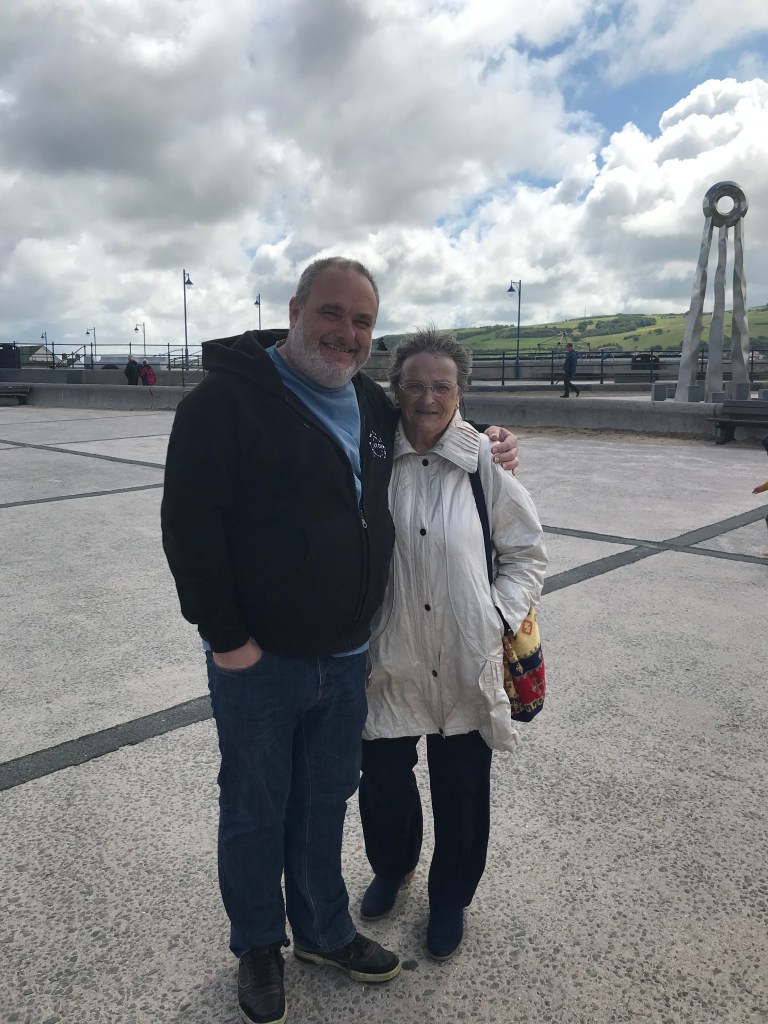
For quite a few years now I have working on myself to create a more balanced sustainable identity that is less self destructive. I had been doing quite a good job, my confidence has grown, I have been more willing to share some of my vulnerabilities, and learn from myself. After my Mum was diagnosed with lung cancer I did take a bit of a dip, but generally I managed to keep myself on a fairly even keel, with a few blips. Then in late spring this year it became clear that Mum was in the last weeks of her life. Myself and Lisa went to see her at the end of May. She was quite well and able to get out and about, we asked her where she wanted to go for a day out. She told us she wanted to go to the seaside. So we took her to Prestatyn, somewhere we used to go with her when the boys were younger. The weather wasn’t great, it was windy and cold, but she loved it. We walked along the front, sat and had a coffee and then had a drive along the coast. That was the last time she went to the seaside.
We went back to Chester in early July, it was very warm but she wasn’t as well. I realised that it would not be long before I would never visit Mum’s home again. I had grown up there, it hit me that it was a huge part of my life. I went around the house one afternoon and took pictures of the rooms and the gardens. I could not bear the thought of me never seeing those rooms again. A few weeks later I was there again, this time though was the last time. At the beginning of August I came back to help care for Mum, as Louise was struggling to keep on top of her pain and Mum would not let her stay. If I came she had no choice but to let me stay. I stayed there until she died on 28th August.
I know I have written about this before, but I needed to write it down to make sense of how I am feeling right now, and to get a sense of what has happened since 2019 when Mum was diagnosed. 2019 and was a challenging year. Mum was diagnosed, Ben left to go to University, I gave up Nursing to work full-time in Organisational Development. My sense of identity was put under severe pressure. Then the next year there was global pandemic, and Jack left to go to University and I couldn’t go and see Mum for months. I think on the whole apart from a little bit of naval gazing and self pity from time to time, and coped quite well. Writing my blog helped a lot. It helped me sort through my shit. Then Mum died, the most important person in my life, she was constant throughout my life. I know how incredibly luck I am to have had a parent that never once let me down. She was not perfect, she got on my nerves, and we had loads of arguments, but she always let me know that she loved me. The first word I think of, when I think of Mum is love. Now she is gone, the gap she has left has shattered the sense of who I am, my confidence has gone, and my anxiety has grown. I am in the process of reframing my relationship with Mum, to fill that gap with gratitude and joy that we were all so blessed to have been loved by her. It is a work in progress, and it is challenging not to revert back to unhelpful self destructive habits. The advantage I have now is that I have greater sense of what is important to me, and this pain I feel is worth it for being so blessed in the first place.
Foggy is still knocking about, but his unhelpful impact is beginning to fade and his helpful function is beginning to come to the fore. Afterall he does help me get shit done.
We used to get our Christmas tree (a real one) the Saturday before Christmas, most people did then (in the 70s and 80s). Now this might not be strictly accurate, but this is what I remember. I remember having real trees when we lived in Chester, even after Dad had left. I remember getting them from Proud’s the hardware store further down Christleton Road, a shop that was used frequently in our family history, being the local hardware store for my Nan and Grandad, where they bought their tin baths, dustbins, mops, and buckets of all descriptions along with paraffin and paraffin lamps for the outside toilet. Nan was a regular in their when I was growing up as well as the post office opposite, that doubled as a bit of general store, where she would get the pies and ham on a Saturday morning before our visit.
Back to the Christmas tree, so we would drag the tree through the house put it in a bucket and wedge it in place with half bricks, we would then decorate it with highly flammable tinsel strands that would get everywhere, I have no clue how we managed to retain so much of the stuff each year as it was nearly impossible to remove from the tree after Christmas, we would randomly dangle the silver and gold strands over the branches, it would always concentrate in clumps when I did it, Mum however seemed to have the knack of throwing it at the tree and it spread evenly. We would add an assortment of glass baubles and other assorted plastic, paper and wooden decorations from the Christmas box, every year we would find a casualty of storage, a broken glass bauble or a dinted plastic one, if it wasn’t too dinted though it might find it near the back of the tree. Mum would then add the lights and the long garlands of tinsel.
Next out of the Christmas bag would be the ceiling decorations. In the mid to late 70s Mum had bought these plastic metallic ceiling decorations that hung down from the ceiling and gentle oscillated up and down as the room heated up, they would also catch the light and glimmer as the gently rose up and down. They were a sight to behold, well for the first few days, then the sellotape that was fixing them in place would give way and they would end up on the floor. This would mean they were regularly being picked up and refixed to the ceiling, until we gave up by Boxing Day, but when they were in full oscillation they were a shimmering thing of beauty.
As reminisce about Christmases past the first memory to return is the smell, the smell of the tree of course, but also the smell of those decorations, they had a distinct plastic smell, like cellophane, it is strange, but that plastic smell reminds me of childhood Christmas every time. I then see the tree with all the baubles reflecting the lights of the tree, and the rest of the room, creating little parallel worlds tinted, red, gold, green and blue. In the days leading up to Christmas I would lay on the floor next to the tree looking up at tree, the baubles, and the lights, listening to Mums Perry Como, Christmas Album getting lost in the beauty of it all.
Christmas Day would always start wonderfully with the anticipation of the presents then opening them, then it would always go downhill, especially when Dad was at home, he would take up residence in the front room and drink and smoke all day. I would go upstairs and play with my presents. After Christmas Dinner we would often be banished to the kitchen and play games around the tiny kitchen table and huddled around the Calor Gas fire whilst Dad snored in the front room in the warm. We had a laugh in the Kitchen with Louise’s boyfriend (future ex-husband) keeping us amused, with his Frank Spencer impersonations. Previous Christmases were spent quietly coking on the cigarette smoke in the front room trying to watch the Christmas afternoon film through the smog of smoke and trying to listen of the snoring of Dad. After he had gone I was older and mostly less memorable, we would still play board games and laugh at Ted.
I would imagine most people have mixed feelings about Christmas even if they dare not mention it. There is so much pressure on us all to happy at Christmas that we feel guilty about not completely enjoying it. Last year I could never have written this for fear of my Mum reading it and upsetting her. Such is the cultural importance of Christmas for many of us that it is nearly impossible to be honest about it, especially in hindsight. Obviously Mum had nothing to be upset about, yes they were not perfect, we would sit and freeze in the kitchen, but the room was full of love. It is ok for Christmas or any other time for that matter to go wrong. It is OK to have mixed feelings, indifference, or outright dislike about Christmas.
The pressure of positivity around Christmas is culturally driven by the media to create an idealised version of family. It has nothing to do with the religious message of Christmas. I would even be as bold as to say the religious significance of this festival has practically been airbrushed out of modern Christmas. Christmas is now about eating overpriced rich food, drinking warm spiced alcohol for about a month, culminating in a day of greed and laziness in the company of people you spend very little time with the rest of the year.
Maybe I am being grumpy, but this time of year can often make me feel less than. I want to enjoy it more than I do, pressure for it to be perfect and happy is high, and I generally fall short of what I want to do. The bread I bake is never quite as good as it could be, the dinner I cook is never as nice as it could, the day doesn’t feel quite as magical as it should.
This year is going to be hard, the first one without Mum, and Ben’s first Christmas living away from home. I know I will be sad; I know we will all have tears in our house. It’s not going to be perfect; I am not going to try to make it perfect. My bread will be enough, the dinner will be enough, I will be enough and there will be plenty of love in our house.












 Connected Coaching