It’s OK to Lead with Compassion

clasped-hands-541849_960_720

When I started as a Student Nurse 29 years ago, my warmth, compassion and empathy were applauded, even considered a strength.

I was not the most technically capable student, my written work was not the best, and I often just did enough. My interpersonal skills however were my strength. I naturally put myself alongside my patients and colleagues. I was always looking for how I could support people, to understand their viewpoint and their experience. Rather than making a judgement on people and their behaviours, my default position is always to see good in people and there is always a reason why people do things. I am not saying I never judge or put nails in peoples coffins. I do everyday as following my default position can be exhausting. It is far easier to follow the path frequently followed, rather than the path less travelled. My preference though is to understand.

This is my point really. the majority of the time warmth, compassion and empathy are not widely valued behaviours in our society especially when shown by men. If you express these behaviours outside of the patient/carer (health professionals) relationship they are seen as a weakness. You are seen as a pushover, weak, lacking toughness, thin skinned, girly. As a teenager and young adult, when I was turned down by a girl or dumped they would always say I was too nice. TOO NICE!!!! That still pisses me off! I never realised that being unpleasant was an attribute to be proud of.

As I said at the beginning my people skills were applauded and encouraged as Student Nurse and a Staff Nurse. I am certain a lot of these attributes contributed to me eventually being promoted to Charge Nurse and given the opportunity to manage my own ward.

fear-299679__340

That was when it all changed. My strengths were now weaknesses, as they would be in wider world. I was sent on leadership courses that encouraged my to be transformational in my leadership, to blend organisational goals with the interests of the staff. To win them over with compassion, but to have accountability. I clearly embraced this approach. However the NHS at that time was not quite ready for this wholesale cultural change. The prevailing culture was still command and control. The I say jump, you say how high culture. I was young and naïve and knew my way of seeing the world was right and everyone would applaud me and thank me for bringing this enlightened leadership to my ward. How wrong I was. I was considered weak for listening to staff and encouraging them to follow their interest. I made quite a few mistakes as all new managers do and that was not the problem, the problem was the under current, the belief that I was a push over and my leadership was not strong enough. People would say that I needed to toughen up, I needed to punish more than I praised and then I would get the respect of my staff. I was constantly made to feel ashamed of my ability as a leader. As a result I started to disengage with my role as ward manager. I could not be that manager, I just could not adapt to being a hard manager. I could not make examples of people. My values would not let be that manager. Therefore I became ineffective, deeply unhappy and eventually mentally unwell. I was just unable to adapt to a way of interacting with people that was the direct opposite of my core values. I was a ward manager for a decade, for the majority of that time I felt deeply unhappy and disengaged with leadership and management. It appeared to me that the NHS as a whole extolled an inclusive, compassionate approach to leadership and management, but actually practiced an adversarial, confrontational approach. I just could not reconcile that gap.

Now don’t get me wrong I do not blame the NHS or the people who practiced this approach, this was and is in some cases the culture they have grown up and live in. This is their paradigm it is difficult and sometimes impossible for them to see the world differently.

Thankfully I had some very supportive people around me that could see what my strengths were and were prepared to help me save my career, and helped me change direction and take up the roles I now have in the organisation, where my behaviours are again considered a strength.

Thankfully the culture not only in the NHS but across society is shifting towards a compassionate, empathetic approach to leadership and management and even living. We now recognise that we need to look after each others mental health in an increasingly complex world. Researchers like Brene Brown and psychologists like Martin Selligman and Stephen Covey highlight how compassion, empathy and happiness have a positive effect on our work and home life. If we lead with compassion your team will be more effective.

If you are a leader that struggles with a command and control approach to management. Getting alongside your staff, finding out who they really are and what motivates them. Listen to what they want and help them succeed in your team. You will reap the rewards. You will have to be brave, accept that you will make mistakes, and learn openly from them.

bridge-3024771__340

If you want to learn more about connecting with your staff and leading with compassion get in touch.

matt@mattycoach71.com

Connected Organisation

Inspirational coaching quotes (2)

Yesterday I told you about my new coaching program, Connected Living. The concept of Connected living came from an idea I had a few months ago entitled The Connected Organisation. Essentially the concept is the same, you first start with the individual and once the individual (the leader) is able to connect with themselves, then they can then start connecting with their team members. The idea being that teams then become, resilient, agile and interdependent internally and with their stakeholders.

The origins of the concept comes from a number of conversations I have had with colleagues and friends about new leadership development programs that we have encountered over the years that have greeted with enthusiasm only to fall by the wayside, once the novelty has worn off. When times get hard we all tend to revert back to comfortable well rehearsed behaviour patterns (habits). Now there is plenty of research based programs and self-help books that teach us how to change our habits, and if you are invested in them they do work. I have definitely changed some of my habits using, books by Steve Peters and Stephen Covey. The knack then is to create a compelling reason to change collective habits that are holding organisations back.

Therefore The Connected Organisation along with Connected Living are not reinventing the wheel, it’s about working with key individuals who then connect with key individuals.

hand-1917895_960_720

So when working with individuals in an organisation there is an element of instruction and coaching to enable those individuals to cascade and coach for connection within their teams. The instruction is simply some coaching concepts, practice and support. The rest of the time is spent coaching the individual to connect with themselves and then connecting with the team.

Connecting with the team explores the history and the culture of the team, what the leader sees as the purpose of the team. What the leader sees as the strengths and weaknesses of the team. What are the team values, and are they congruent with the values of the wider organisation. Is there a perceived gap between the teams values and the teams actions. zen-2040340__340

Once they have started to create a connection with the team as a whole, then the leader is able to start to connect with the individuals in the team using the coaching skills and knowledge they have learned within this program. To ensure the coaching the leaders is giving is useful the leader needs to connect with other leaders for supervision and support on a regular basis, to prevent the shift back to old habits.

I am still adding the detail to The Connected Organisation before it is ready to be rolled out. If you are interested in exploring this approach further, please get in touch.

matt@mattycoach71.com


Connected Living

Connected Living

Over the past month I have been working on a new program of coaching. Looking at all the research about effectiveness (both personal and team) it seems that trust, connection and empathy appear to be vital.  Therefore I started to put together a program that brought together these ideas from, drawing on the work of Brene Brown, Martin Seligman, Steve Peters, Stephen Covey, Myles Downey, and John Whitmore.

girl-2573111__340.jpg

Connected Self

The first part of the program explores how you connect with yourself. This looks at what drives our wellbeing and provides a quick wellbeing health check using Martin Seligman’s PERMA framework. We then look at what makes you feel vulnerable and what drives that. Next we will explore your beliefs, and values and you will be invited to start to work on your personal mission statement, based on your values and what you what to impact you want to make on yours and others lives. Now you have explored your beliefs and values we can then return to your vulnerabilities and understand what triggers these vulnerabilities and drives you to think more emotionally than rationally, allowing you recognise when you are thinking with your emotions. We will then discuss your behaviour preferences, so where you get your energy from and whether you prefer to think things through using data, or whether you prefer to react on what feels right for you and others, or whether you can switch dependant on the context of what is going on. Once you start to understand how and why you do things, or not do things, you will then start to appreciate and understand your whole self. When you are self-aware you are much more likely to be able to connect more effectively with others.

decoration-3583043__340

Connected to Others

Once  you have started to connect with yourself you can then start to explore how you connect with others. Firstly we will look at how you manage your current relationships by asking questions based on Brene Brown’s BRAVING framework. This can provide you data for setting your goals and action planning. We will then explore how much of a coaching approach do use when communicating with people around you, do you like to explore what they want and help them find the way to do achieve it that suites them best or are you someone who prefers to tell them how to do it, based on your experience so they can avoid all the mistakes that you made on the way. Based on your beliefs and values we will discuss what you value in the groups and teams you populate and what causes you discomfort. Now you have collected your data we can now explore and set your goals for improving your connections or creating new ones. I will then support you through action planning and reviewing progression.

bridge-3024771__340

Loss and New Beginnings

Once you are connecting more effectively you will be in a much better position to manage change within your personal or work life. Drawing on some of the work of William Bridges we can explore how you manage your transition from the old way of doing things towards your new beginnings. We will look at the feelings that emerge during this transition and the effect that has on you and your connections. Again we will set goals for you to achieve to realise your new beginnings

If you are interested in connected with yourself and others email me matt@mattycoach71.com
Further Reading

Brene Brown: Daring Greatly: How the Courage to be Vulnerable Transforms the Way We Live, Love, Parent and Lead. London Penguin Life 2012

Stephen R. Covey: The 7 Habits of Highly Effective People. London, Simon & Schuster 1999

Prof Steve Peters: The Chimp Paradox; The Mind Management Programme for Confidence, Success and Happiness. London, Vermilion 2012

Myles Downey: Effective Coaching. London, Texere 2002

William Bridges; Managing Transitions; Making the Most of Change. London, Nicolas Brealey 2008

Martin Seligman: Flourish. London, Nicholas Brealey 2012

Is your ladder of success up against the right wall?

I was minded to think about my anxieties this morning. An old friend, posed a question on social media asking for advice on any techniques for reducing anxiety. The response he got was overwhelmingly supportive, with many of his friends jumping to his support, and advising him on what had worked for them. They immediately made themselves vulnerable and connected with a friend in need. They showed him how loved he is by them and how much they value him. They were prepared to share their experiences with their anxiety to help him. I too shared my feelings and experience to help a friend who is always warm and generous, even though we have not actually been in the same room with each other for more than 30 years. We have for the passed 10 years reconnected with each other via social media, where he has always shown generosity of spirit. I think what I am saying about this friend is that he is rich, he has an abundance of kindness and empathy that he gives freely, and therefore many of his friends are willing to give it back when he needs it. He made himself vulnerable and reached out for help and we all reached back.

So as I said this made me think about my anxieties and what triggers them. Every time they are triggered by a sense of failure, worthlessness and generally just not being good enough. In other words I haven’t succeeded and I am never likely to succeed. Clearly this is very melodramatic. This is though how people that experience anxiety can see themselves.

Much of this self-talk is based on me comparing myself to a version of success that I never likely to achieve or if I was honest with myself I would never want to achieve. It is based on what our society and culture has deemed as being successful. This for me is a combination of the masculine paradigm described in last weeks blog (Vulnerability), body image, and being financially rich. All of these paradigms of success are reinforced on a daily basis through mainstream media, social media, and our cultural environment. The majority of us are conditioned to constantly want more, to feel that we do not have enough. Being happy with your lot, being satisfied and content is frowned upon. Saying you have enough or are enough shows lack of ambition, and ambition should be praised.

12744715_10205996399086157_671955865714201384_n

I know I will never succeed to achieve what our society deems as success, to be honest most of us won’t. But social media allows us to show our friends snapshots of aspects of our life that might suggest that we are achieving this success. We all love doing it, taking pictures of our holidays, our food, the selfie that we think makes us look thin, applying filters to our pictures to make them appear dreamy and romantic. They make us feel superficially successful and highlights others scarcity. There lies the problem when we do this, we lack empathy we make others feel like they have less than us. If we are honest the only reason we did it was because our friends made us feel inadequate the week before. So we end up perpetuating scarcity. This paradigm of success is not our success. If you want to start feeling less anxious and more fulfilled you need to discover what your version of success looks like.

As Stephen Covey suggested, is your ladder of success up against the right wall? What do you want to get from your life? What adds value to your day? If your life was to end tomorrow, what would you want your friends and family to say about you? What impression do you want to leave?

walking hollie

I know I have talked about values before, by they are vital when you want to measure how successful you are, and how you should live your life.

Make a list of what you value the most. If you are unsure of what holds value in your life, ask yourself what parts of my life are immovable objects. They are generally what you value the most.

Next imagine that you are 100 years old and you are passing on advice to a young member of your family who is about to leave home and embark on their adult life. What do they need to do if they are to lead a fulfilled life?

These 2 exercises inspired by Professor Steve Peters’ life stone will help you identify what you consider to be a successful life. Does your life, live up to your values and are you living the life you consider to be a fulfilled life? If not what do you need to do to achieve this successful life.

This is something I have done. I have discovered what I think is success, which is what is valuable to me. Which is being warm, empathetic, courageous, and generous, then sharing those qualities and improving peoples lives. I am not quite there but I am a lot closer to this than being a multimillionaire with a six pack! I am pretty certain my ladder is up against the right wall.

img_2120

If you are having trouble knowing that you are up against the right wall, then get in touch. Remember you are enough, you do have it in you to be successful.

13-standing-on-top-of-the-highest-mountain-in-the-world

Vulnerability

If you follow my Facebook you will have noticed I have been posting about being vulnerable and what might prevent us from taking a risk (making us vulnerable). As you may have guessed I am reading a new book. I discovered Daring Greatly by Brene Brown, and what a revelation it has been. I have been embracing my vulnerability and examining my shame ever since. I have found myself shoehorning shame and vulnerability into nearly every conversation I have at work.

If you have not read it, I implore you to do so, it has definitely changed they way I view my life.

To give you a taster of whether this is up your street, I will explain to you the biggest impact this book has had on me.

First lets explain what Brene means when she talks about being vulnerable. We make ourselves vulnerable when we do things that are not guaranteed to end in success. Being vulnerable is when we put ourselves in situations where we might be criticised, attacked, rejected, or just ignored. What prevents us from being vulnerable is shame. Shame is when we attach what we do to our self-worth. So if we fail it is that we where not worthy of success. Shame is shaped from external cultural influences, such as our family, work, religion, or wider society. Brene suggests that men and women can experience shame differently. She describes women shame as web, as it is complex and often contradictory potentially trapping women in a web of shame. Men she says experience a box of shame, where their shame keeps us inside a box of conformity.

Now let me explain this a little further. In her book she describes research in to feminine norms and conformity carried out in the US. This research compiled a list of attributes associated with being feminine:

  • Being nice
  • Pursuing a thin body ideal
  • Showing modesty, by not calling attention to ones talents or abilities
  • Being domestic
  • Caring for children
  • Investing in a romantic relationship
  • Keeping sexual intimacy contained within one committed relationship
  • Using their resources to invest in their appearance

I know at first read you think those Americans, they are so backward. If you think that, read it again and think about your life and the women around you, and the attitudes of the media we are exposed to. These attitudes are still prevalent, if not overtly, they are still prevalent in peoples heads. Add to this attributes that are required professionally for women, to be strong minded, driven, the best you can be, be bold and decisive, and you can see that complex web of shame can develop.

The same research listed masculine attributes:

  • Winning
  • Emotional control
  • Risk-taking
  • Violence
  • Dominance
  • Playboy
  • Self-reliance
  • Primacy of work
  • Power over women
  • Disdain for homosexuality
  • Pursuit of status

When I first read this I objected strongly to a number of these statements, and then I thought about growing up as a young man and the conversations I have in the company of men (mostly men that I do not know well) and the majority of these attributes are very evident. I remember in my youth feeling uncomfortable with the fact that I did not share these attributes with men and would often feel shame when in the company of men. For a British man I would add being a pack member (something again I did not partake in comfortably as a young man, causing me shame). The most important message given to men is not to be weak. Never show weakness. On top of that modern man has to listen, be sensitive, and be kind, but if you show weakness whilst doing this you have had it. So men can end up trapping themselves in a box to prevent them from feeling shame

After reading this section of the book, my life fell into place. I have been experiencing shame all my life, along with all my friends. When my old teacher told me I was culturally deprived she was describing my shame for not possessing masculine attributes. I now completely understand Foggy (my negative self talk) as a manifestation of my shame for not being strong and masculine.

I am beginning to understand what triggers my shame. These things that I do that trigger my shame do not define my self-worth. What defines my self-worth is that I can make myself vulnerable. The fact that I can be sensitive, and show emotion, means that I can show empathy to others and care for people that are feeling shame.  I am enough and I am worthy of everything I receive (good or bad).

Writing this blog makes me vulnerable, and I know that I will beat myself up about it after I have published it. Up until 5 minutes before I started writing it, I was telling myself that no one would read it or like it. In fact that is the risk I am taking, but this blog is not attached to myself worth. If no one reads it or likes it, I will be disappointed but it does not make me useless and worthless as Foggy would have me believe.

If you want to do something because you enjoy it, do it (as long as it does not result in hurting others). Do it because you can, because you are worthy, and you are enough.

Brown, Brene. Daring Greatly: How the Courage to Vulnerable Transforms the Way We Live, Love and Lead. UK: Penguin Life, 2015.

fear-299679__340


Next step for Vialetters

Vialetters (my eldest is the Bass player), have taken the next step to getting their music to a wider audience.

Through their persistence and hard work, the band have managed to get a song professionally produced and have released on Spotify. Their level headed and patient approach to working towards their dream is inspirational. They are under no illusion they have a long to go to realise their dream. Each time they perform and write new songs the nearer they get to that dream. If you have Spotify have a listen, if you like it add it to one of your playlists and share it. I think it is brilliant but I am biased.

Vialetters- Geosmin

Happy Birthday My Old Friend

This week saw the 70th Birthday of the NHS.

The NHS provided the Midwives and GP that brought me into the world. It trained the surgeon, anaesthetist, nurses, ODPs, play specialist, porters, caterers and cleaners that looked after me when I had grommets inserted into my ears, to get rid of my glue ear.

When I was 16 the Nurses, Doctors and Physiotherapists at City Hospital in Chester inspired me to be a Nurse.

When I was 18 I moved to Hull and trained as a Nurse, at the Hull District School of Nursing.

When I was 21 the NHS gave me a job as a Staff Nurse on a Children’s Ward.

When I was 23 the NHS trained me to be a Children’s Nurse.

The NHS took me on as a nervous homesick boy and turned me into a compassionate, competent, professional Clinical Nurse Educator and Coach.

The NHS has been by my side, helping me become all I am today for the past 29 years.

The NHS has and always will provide outstanding health care to all and for free at the point of access. This is an incredible achievement. In fact is is miraculous, when you think of the scale, and the incredible progress that has been made over 70 years.

There are people who have experienced major trauma or sepsis in recent years who are alive, that would not have survived even a decade ago. Some of the routine work carried out in the NHS today would have been unthinkable when I started my career at the end of the 80s. All of this is done with challenging finances, and under the glare of constant political and media scrutiny.

NHS is not just a health service, it is at the heart of who we are in the UK. Let’s not take it for granted, and let’s never lose it.

Thank you NHS for being there for me all my life.

On Thursday I attended The Hull and East Yorkshire Health Expo. This is an annual event showcasing healthcare in Hull and East Yorkshire. This is our chance to show the breadth of services the NHS provides locally and the diverse career opportunities available in the NHS. This year’s event was incredible with it being the anniversary of the NHS. I had a great time, getting people to make smoothies on our smoothie bike, meeting and greeting and talk about careers in Nursing.

I know this has not had much coaching content, but I wouldn’t be a coach if it wasn’t for the wonderful NHS. So I needed to celebrate this incredible national treasure.

Being a Parent

Being a parent is a privilege, on the whole it is wonderfully rewarding experience, watching your child grow, and develop.

However it is also exhausting, stressful, and sometimes terrifying. We are after all hard wired to protect and nurture our children, we can’t help it we just do it.

When our children are young we develop eyes in the back of our heads, and survive on a few hours sleep (mums especially). This behaviour can be confused as neurosis. We all remember that look on the GP’s face when they see you in the surgery for the tenth time in a month with baby David’s rash, cough, funny eye, etc, etc…

Then before you know it they are starting school and you turn into a blubbering wreck. This doesn’t last and soon you start to relish school, some of you live the time to get back to work others relish the support network that develops at the school gate. You start to connect with you fellow neurotics. It is they say good to share your pain.

This network can be a double edged sword, with stress and anxiety creep in when you realise that Tabitha and Sebastian are on a higher reading book than Dave, and Sebastian is tipped to be the next David Beckham playing for the local under 7s. You start taking David to football, horse riding (good for balance), chess club ( intellect), and Guitar lessons (he could be the next Ed Sheeran). Your exhausted, Dave is exhausted and to be fair he is shit at all of them.

Within a blink of an eye your child is leaving Primary School and heading of to High School. And you thought starting Primary School was stressful!

The first 2 years at High School are fairly benign. Then puberty hits! This coincides with GCSES. You might call it a perfect storm. Hell on earth is more like it. If you have boys (I have boys so it might be the same with girls, I don’t know) the first thing you notice is the smell. They start to sweat a lot! Then they stop talking at length and barricade themselves in their room, making the smell worse. Every now and again they will come down, so you ask them how school is going, how is revision going, what subjects might they want to study in 6th Form. You know show an interest in their lives. Big mistake you get accused of interfering in their lives and interrogating them. So you answer back and before you know it you are in the midst of a full blown row, started by asking how they were!

Then they go and do something that stops you in your tracks, that might be something kind and thoughtful, or pass their exams, or produce something amazing. Your heart swells and you remember how proud you are and how much you love them.

As they get older you spend less time in contact with them, but the same amount of time worrying about them. There comes a time when you realise that they are not children anymore, and your role as parent is going to change, and pretty soon it will be more of a distant role. I am at the start of this stage and let me tell you emotionally it is draining. I am having to come to terms with a change in the way I support them, and it is hard.

Each of us is going to experience parenthood differently, and parenting one child is different from parenting the next. So everyday as a parent is a pioneering day. We are always on virgin territory, we are never going to be experts in parenting. Just when you think you can apply what you have learned from experience, you child bowls you a googly.

So give yourself a break, stop comparing yourself to your friends and family. Every family is unique. Also remember your child is new at this too.

If your are stressed and tired, but feel so proud that you could burst then you are on the right lines.

Enjoy your journey, you only travel this way once.

Music on my commute to and from work

It’s been a while since I shared a playlist.

I am not sure if anyone listens to them, but I really enjoy putting them together.

With it being Mental Health Awareness week it is important to remind ourselves to give some attention to our mental health. One suggestion is to do something everyday that you enjoy, if you can it is best to spend an hour doing something that makes you happy. Now putting together this playlist took slightly less than an hour. So I have another 45 minutes left to fill today. Now that is fairly easy on a sunny Saturday. However during the week that can be a little more challenging. Trying to fit a an hour in our busy days can feel a little indulgent. Trust me, it isn’t, it is vital, vital for your health and well-being.

So if it is we have to be a little more imaginative about how we fit that time in. Firstly though we all need to examine our days, and think about those activities we do in a day where we derive enjoyment, that could be spending time with our children, taking the dog for a walk or cooking. Create an inventory of enjoyable activities, once you start you will realise how happy you can be simply by appreciating the things you already do. When you add them up you may be halfway there. Now cherish those activities, and if you need to move them up your importance order.

Once you have created your inventory, then look at those redundant parts of the day, such as your commute to work. My commute is about an hour a day, 30 minutes there and 30 minutes back. To fill that time I know put my music library on my phone on shuffle and sit back and listen. Now I have a couple of playlists that automatically update with new music that is downloaded onto my phone, so when engage the shuffle option I can listen to a song for the first time. Therefore that anticipation of not knowing whether I am going to listen next, it could be an old favourite or a new classic is so exciting.

My boring 30 minute commute is transformed and flies by. So why not in the car, on the bus or train put your music on shuffle sit back and see what happens. For me I have nailed in hour of happiness.

Because I like to share here is a playlist made of a shuffle I did this morning, not on a commute but sat on my sofa. Have a listen if you like, if you don’t that’s ok too, I have had my fun.

My commute shuffle

A walk up Snowdon

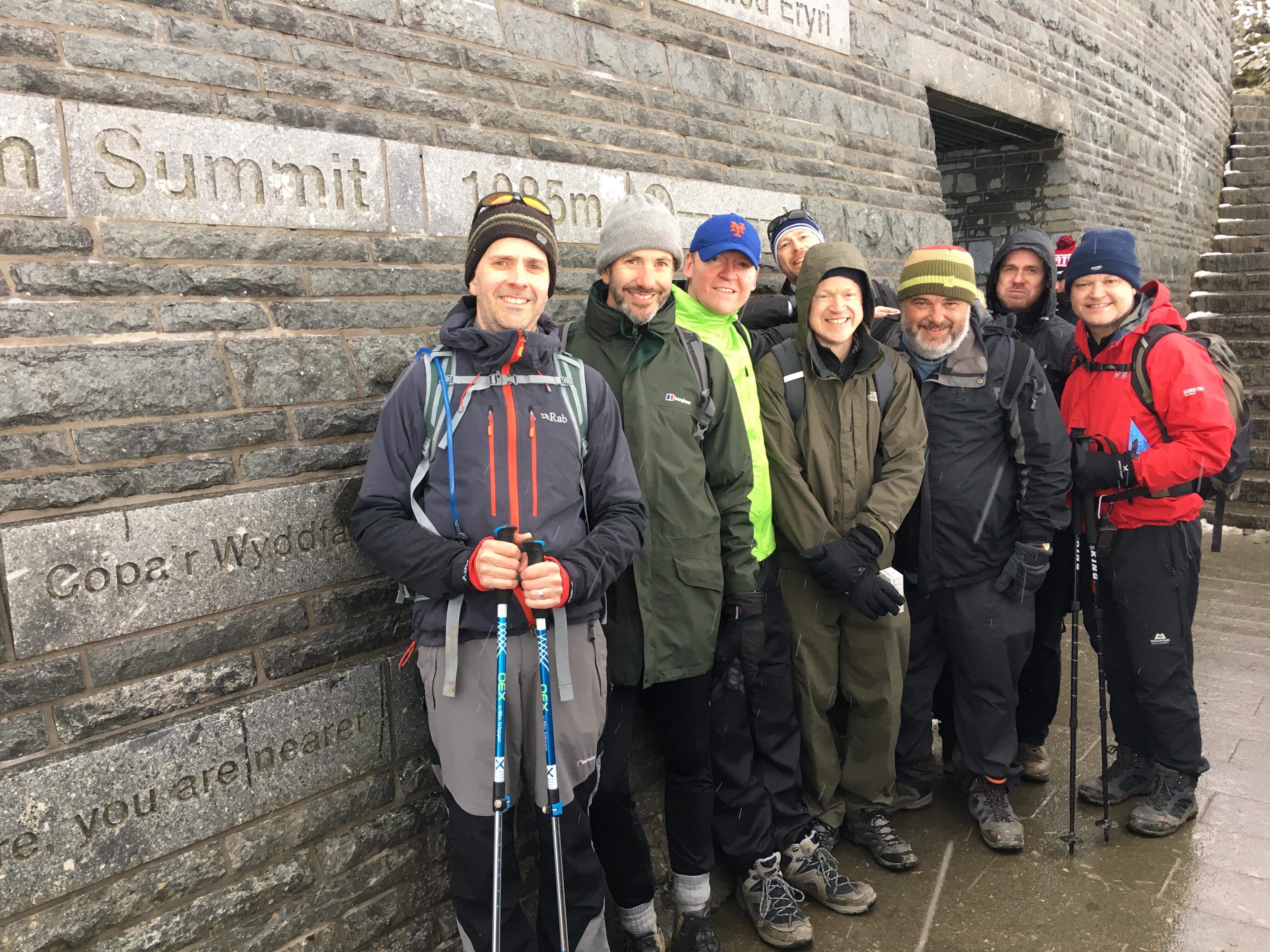
Last weekend , I met up with a few of my old school friends, and we went for a walk up Snowdon, as you do!

Now normally we meet up in a pub in Chester, have a meal, reminisce and get hammered. Not all of us manage to get to these sessions and even when most of us are there we don’t always get the chance to speak to everyone before we all go our separate ways.

Well back in December most of the lads, not me however, met up in Chester, and the idea of spending the weekend together, and hiking up a mountain was formed. All the best ideas are born in a drunken stupor, don’t you think!

Luckily the idea did not fade with the hangover, but actually grew and by late January early February had become a thing, a thing we had all become committed to, both financially and philosophically. Many of us in the group (when I say many, I actually mean myself and possibly Lee) had no idea what the reality of walking up Snowdon was. Thousands of people young and old walk, run and even cycle up Snowdon every year. Colin even did it over Christmas when it was -15 (I will get back to Colin later). So how hard could it be.

So the day came to travel to Chester to meet up with my friends and travel on to the farmhouse we had hired for the weekend (their was 8 of us and it was quite reasonably priced before you think of us as flash gits). I was so excited, it was like Christmas Eve when I was 5.

We stopped off on the way to collect supplies in Colwyn Bay. My advice would be if visiting Colwyn Bay, do your shopping before you get there. This shopping experience however did not dampen my excitement.

When we arrived Colin and Rich Turner (there are 2 Rich’s) decided to test out a route before the main ascent the next day. Like 2 demented fools myself and Lee gleefully volunteered to join them. My glee soon soured as we clambered up a hillside through muddy fields and over styles. I thought my legs were going to fall off and my lungs explode. Rich informed us that this was a trial to see if we could cut across to the trail we would use tomorrow to prevent us from walking along the road for half a mile. When we reached the said trail, I thought to myself how the fuck am I going to walk all the way to the top tomorrow. What had I committed myself too. I had seriously over estimated my level of fitness and ability to walk on slopes. It was like waking up on Christmas morning and discovering that Christmas was in fact just a really long Maths exam. I didn’t want to show myself up too much, however the few of us that had taken on this mini adventure had witnessed my distinct lack of ability on slopes.

Fuck it! I thought, give it a go, and see what happens, I said to myself.

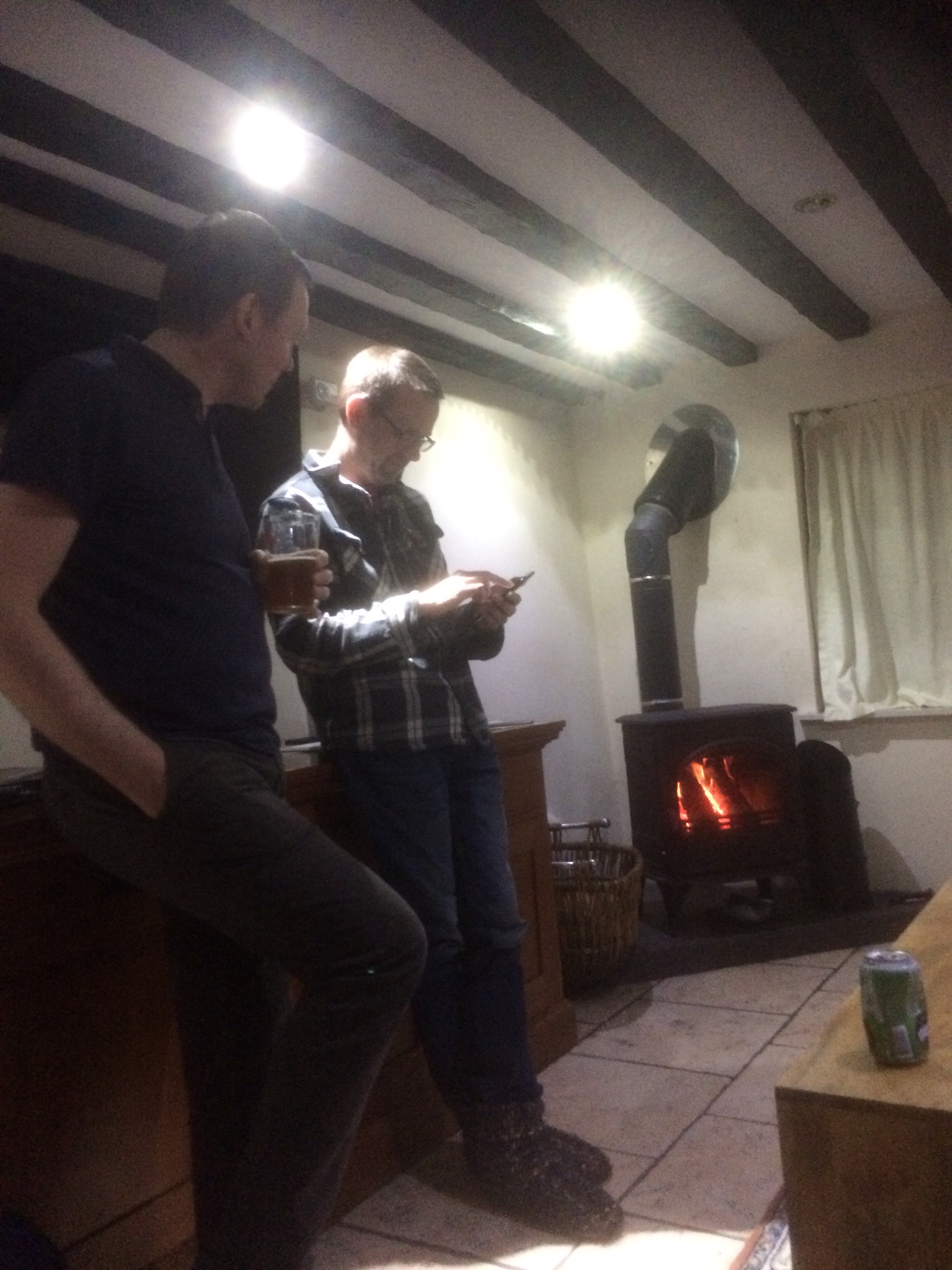
Ian had stayed behind during our recce to cook tea, and what a fantastic tea it was, veggie chilli, and tequila! The rest of the party except Rich J arrived later that evening, and much merriment and laughter ensued.

Throughout the evening and into the night, I grappled with my self 1 telling me to bow out, fake an injury or illness, anything just don’t do it, because at best you will look fat and useless and at worst you might die, self 2 saying, just do it, think of the views, the sense of achievement.

I went with self 2 clearly but resolved that I would go at my own pace, just to keep self 1 happy.

Rich J arrived just after breakfast and we set off. We walked along the road to the Ranger trail, we had decided that was a sensible option.

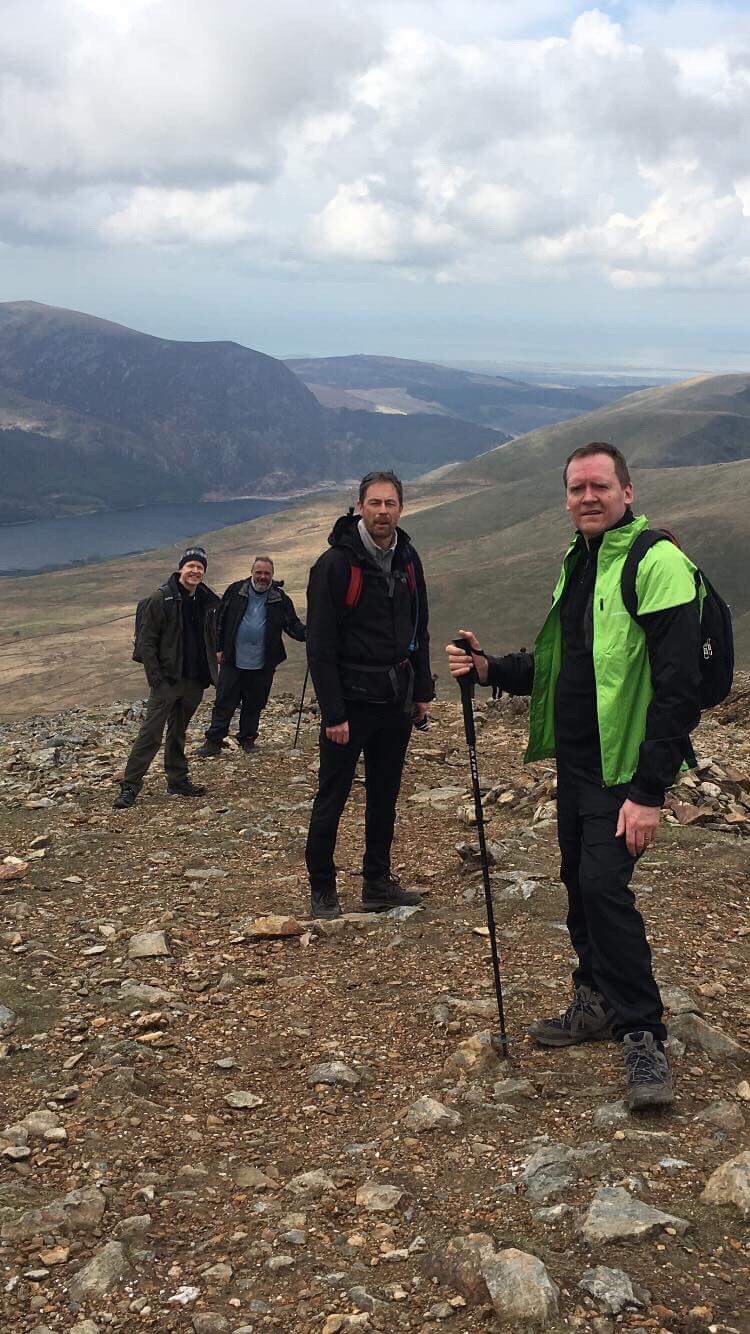
When we got to the trail, I struggled from the off, and had to stop regularly to release the tension in my back or get my breath. My fitter, and thinner friends were all very understanding and regularly waited for me or walked with me. Colin being super fit, went off ahead (he had already run 7 Miles before we set off). At times the others were grateful to take to wait for me and have a breather. I was determined to finish, to reach the top. To do that I had to go at my slow pace. This walk up Snowdon had turned into a personal battle. My self 1, the cautious me, wanted to stop and go back, my self 2, the spontaneous me, the achieving me wanted to carry on. Throughout my life when it came to physical achievement, and pushing myself, self 1 would nearly always win. This time self 2 was going to win. I used Colin as a focus, to me Colin always appears to let his self 2 take the lead, so during that walk up Snowdon I was allowing Colin to inspire and motivate me. He didn’t know he was doing it, he was doing something he enjoyed. I needed something or someone to focus on and Colin fit the bill. I imagined him waiting for me at the top and that thought pulled me up. Every time I wanted to stop, Colin said to me give it another 5 minutes then see how you are. (Colin never said that Colin was too far ahead to notice me) That got me to the top.

When the summit came into view I cried, in fact I wanted to break down and sob. I didn’t, I managed to hold myself together. I had done it, I had managed to prevent my self 1 from getting me to give up, my self 2 had one. This personally was a landmark moment in my life. That is why I wanted to breakdown and cry, I was so relieved.

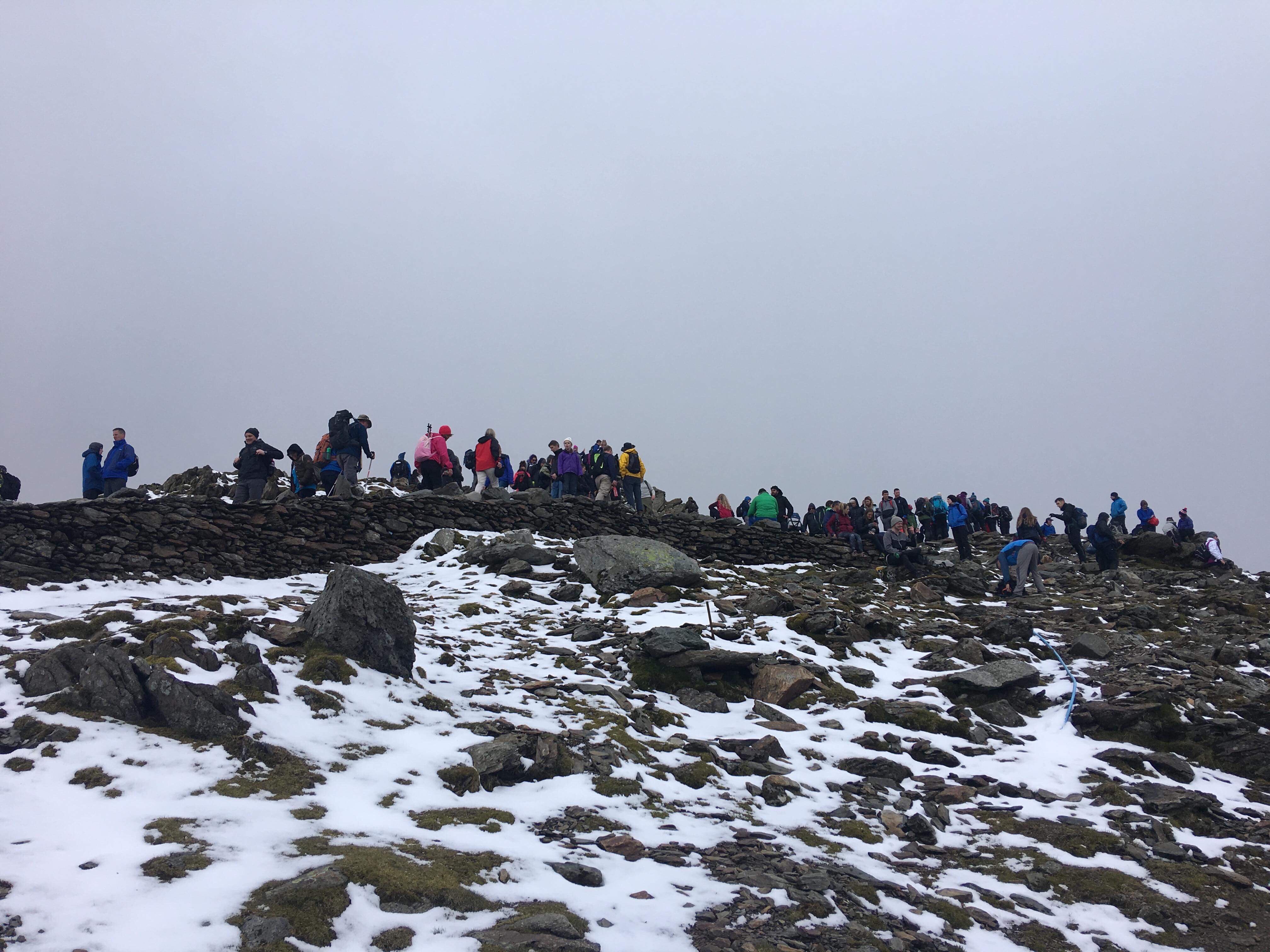
Anyway enough sloppiness. When we arrived at the top, it was packed, there was a queue to the summit! Worse still the cafe didn’t open for another week, and it was snowing!

After some food when started our descent, via another trail, this trail was partly along a ridge that Rich T said was nice and safe. He might have thought that! I was terrified! Looking at some of the pictures the views from the ridge were incredible, I couldn’t see them, I had lost my peripheral vision by this point.

This was harder than the ascent, most of the time we were scrambling down rocks, trying not to slip. Again my athletic prowess meant that I brought up the rear. I was cold, wet and mentally and physically exhausted when I arrived in the pub nearly 6 hours after we set off.

That first pint was the nicest pint I ever had. After another we all went back to the farmhouse for showers and food this time cooked by Rob. We had a selection of curries, That frankly were wonderful.

That evening was a little more subdued, than the evening before and a little less alcohol was drunk, but still a wonderful evening was had nonetheless.

After a fitful sleep and a hearty breakfast we said our goodbyes, with a promise of doing something else in the autumn, perhaps a little less challenging than Snowdon.

After coming back I have felt strange a little subdued, and a little unsure of myself. Whilst writing this I have realised why. That weekend I did something I rarely do, I pushed myself beyond the limits I set myself. I realised that I am really unfit, and I need to do something about that. More importantly I have learned that I can go beyond what I think is my limit, all I have to do is listen to self 2 more. It is easy said in coaching sessions, but doing it is different, now I understand how I can turn my self 1 down. I know I can achieve far more than I think I can.

Being able to use this experience in my coaching will be invaluable. Giving the client the space to explore what their self 1 and self 2 are saying to them, will help them determine who has the stronger voice and who needs to have the stronger voice.